The Pingdom alternative that wakes you.
Pingdom does polished uptime and response-time monitoring, at an enterprise price a small team feels every month. Sitedown gives you the same clear multi-region monitoring, branded status pages and a call-style phone alarm, for one small-team price.
Free, no card. Add your own site and watch it in under a minute. See how it works · Pricing

Sitedown vs Pingdom, feature by feature.
The same uptime you rely on, plus the confirmation, status pages and alarm most teams wish they had switched to sooner.
| Feature | Pingdom | Sitedown |
|---|---|---|
| Uptime & response time | ||
| Real-user monitoring | Partial | |
| SSL & domain expiry alerts | ||
| Branded status pages | ||
| Maintenance windows | ||
| Incident management | ||
| Call-style phone alarm | ||
| Affordable for small teams | ||
| Starting price | $10/mo | $4.95/mo |
Why teams pick Sitedown over Pingdom.
Pingdom is one of the most recognisable names in monitoring, and for good reason. Its transaction checks, response-time waterfalls and real-user monitoring are polished, and large teams have trusted it for years to prove exactly how fast a page loads for a visitor in Frankfurt versus one in Sydney. If deep performance analytics are your priority, Pingdom is a serious tool.
The catch that sends people looking for a Pingdom alternative is the bill. You are paying an enterprise line item for what is, at its core, uptime and response-time monitoring. Sitedown keeps the signal you care about, uptime, response time and SSL and domain expiry alerts, publishes branded status pages, and rings a call-style phone alarm when something real breaks, at small-team pricing.
A good way to decide is to look at what a monitoring bill is meant to buy. Pingdom proves your page is fast and up. Sitedown proves the same thing, from multiple regions with confirmation before it pages you, and gives your users a status page to watch during an incident. The free tier needs no card, so you can try it beside Pingdom before you touch your plan.

Switching from Pingdom to Sitedown.
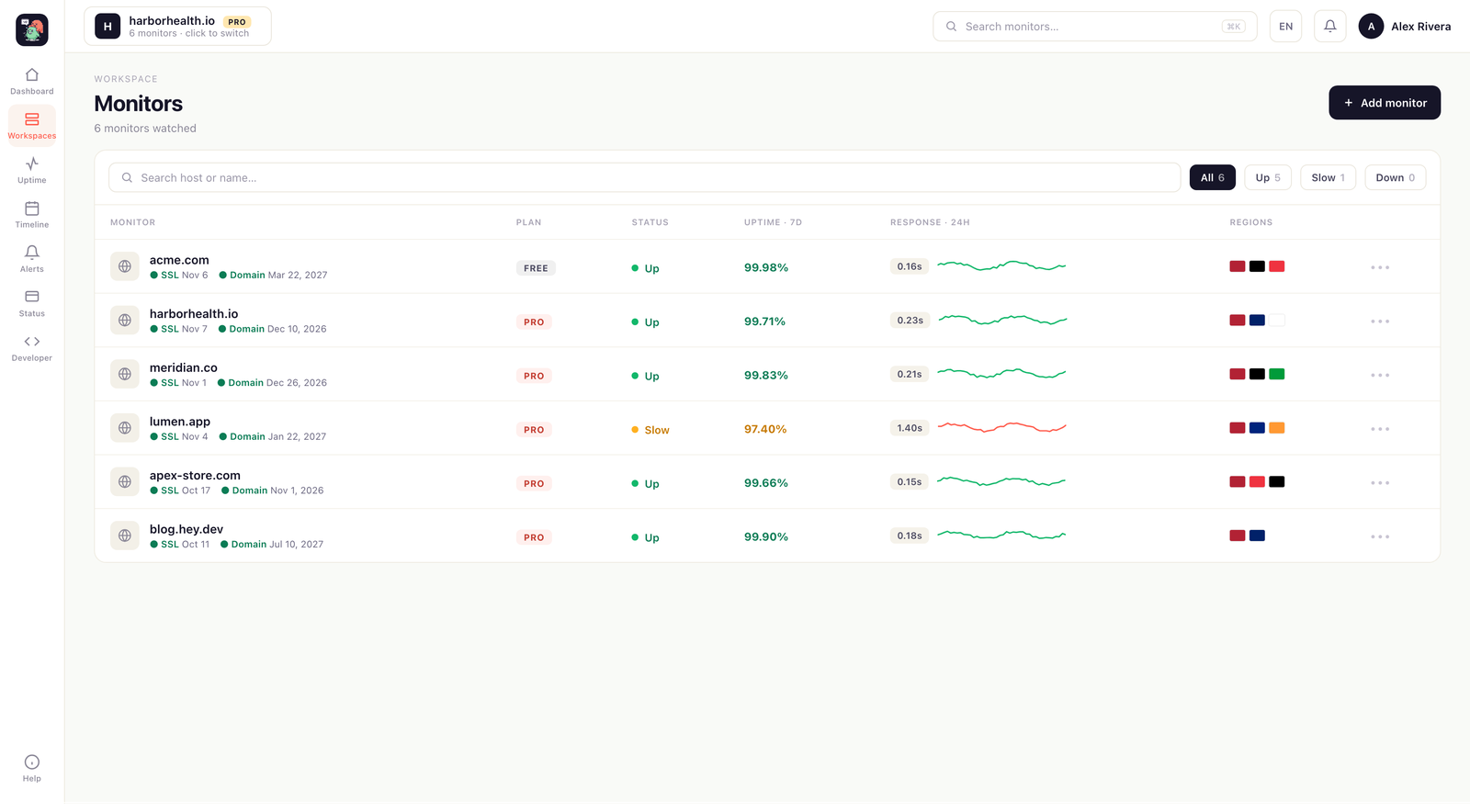
Moving off Pingdom, you keep the monitoring that mattered: uptime checks, response-time tracking, SSL and domain expiry alerts, and branded status pages your customers can watch during an incident. Multi-region confirmation means a slow node in one city does not fire a false page. For the vast majority of sites, this is the performance visibility you were paying Pingdom for, without the enterprise contract wrapped around it.
What is new is the alerting and the price. Checks run as often as every minute, response-time history flags a slow site before it goes down, and when something breaks the alert reaches you through Slack, Discord, Telegram, email, webhooks and a call-style phone alarm that rings through Do Not Disturb. Status pages sit on your own domain with 90-day history and incident timelines.
Because there is nothing to install to begin, migration is a matter of adding your site and pointing your team at the new dashboard. The free tier has no card, so you can run Sitedown next to Pingdom for a week and compare before you cancel anything. Annual billing lands about 25% below monthly.
Free site monitoring, not a trial.
Most people looking for free website monitoring end up on a 14-day trial that turns into a bill. Sitedown gives you real free uptime monitoring: watch 10 monitors on a 15-minute interval, get a branded status page, and keep SSL and domain-expiry alerts, with no credit card. It covers website, API and server uptime with response-time history and mobile-app alerts, so you see a problem the moment it starts. When you outgrow uptime monitoring free, one flat plan adds one-minute checks, multi-region confirmation, every alert channel and unlimited status pages, no per-seat tax. Website uptime monitoring free is a real plan here, not bait.
Compare Sitedown with the rest.
How to switch from Pingdom without a monitoring gap.
Migrating off Pingdom is a five-minute job, not a project. You keep Pingdom live while you set Sitedown up, move your sites and alerts across, publish a branded status page, and only then cancel. Here is the exact order.
-
01
Keep Pingdom running while you set up
No rip-and-replace. Create a free Sitedown account and add your sites there first, and Pingdom stays live the whole time, so there is never a monitoring gap during the move.
-
02
Add your sites and endpoints
Point Sitedown at the same URLs, domains and API endpoints you watch in Pingdom. Uptime checks, SSL and domain-expiry monitoring and a public status page turn on the moment a site is added: no agent to install, no DNS change.
-
03
Wire up the alerts you already use
Connect email, Slack, Discord, Telegram or a signed webhook, and install the Sitedown Alerts phone app. The call-style Alarm level rings through silent mode and Do Not Disturb for the 3am outage you cannot sleep through, something Pingdom cannot do.
-
04
Publish a branded status page
Stand up a status page on your own domain with real 90-day history and incident timelines, so your users stop emailing "is it just me?" during an outage. It goes live in minutes, with nothing Pingdom asks you to host yourself.
-
05
Run both for a cycle, then cancel Pingdom
Watch the two side by side for a billing cycle. Once you trust the Sitedown checks, alerts and status page, cancel Pingdom and consolidate. Most teams find the multi-region confirmation and the phone alarm are the parts they wish they had switched to sooner.
Frequently asked questions.
Everything people ask before they switch from Pingdom. Still unsure? We are one message away.
For most teams, yes. Sitedown covers uptime, response-time and SSL and domain expiry monitoring plus branded status pages at small-team pricing, and yearly billing is about 25% below monthly.
Sitedown focuses on synthetic uptime and response-time checks from multiple regions rather than deep browser-side RUM. If detailed RUM waterfalls are your core need, keep them; if you want clear multi-region monitoring and status pages at a fair price, Sitedown is the better fit.
Yes. There is nothing to install to start monitoring, so you can run Sitedown alongside Pingdom, confirm the checks and status pages behave, then cancel Pingdom on your own schedule. No configuration export is needed.
Yes, and it needs no card. Free covers uptime monitoring, a status page and the mobile app. Pro adds one-minute checks, multi-region confirmation, response-time history and every alert channel.
Alerts fan out to Slack, Discord, Telegram, email, webhooks and a mobile app. The app can ring a call-style alarm that sounds through silent mode and Do Not Disturb until you acknowledge it, which is stronger than a standard email or SMS notification for a 3am outage. You choose Silent, Notification or Alarm per site and per event.
Better monitoring, for free.
No card, no install. Add your site and get multi-region uptime checks, SSL and domain expiry alerts, a branded status page and a phone alarm in one account.